If you’re hearing about H100® for the first time, explore these resources to learn how it works and how it may help your patients:
Understand how H100® may reduce curvature, pain, and scar tissue
Review published research and abstracts demonstrating H100®’s effectiveness
Learn how stretching exercises can enhance results when combined with H100®
Learn the basics about Peyronie’s disease, its symptoms, and treatment challenges
Thinking of prescribing H100® for Peyronie’s disease? You’re in the right place.
Below you’ll find everything you need to get started—from writing the prescription, to pharmacy details, and research that supports H100® treatment.
If you’d like something to share with patients, be sure to download our H100® Patient Brochure below for a clear, easy-to-understand overview they can take home.
Prescribers can send in the H100® prescription to PD Labs in one of two ways:
💡 For faster service, call PDLabs 1-800-687-9014, request a PASSWORD and click this link to enter or you can email info@pdlabsrx.com to request a password. Then you can access PDLabs prescription form to ensure complete information
Whether faxing or calling, be sure to include:
Including these details helps PD Labs reach the patient promptly and begin fulfillment
Once the prescription is received, PD Labs will:
Int J Impot Res. 2016 Mar-Apr;28(2):41-5. doi: 10.1038/ijir.2015.22. Epub 2015 Dec 24.
Topical treatment for acute phase Peyronie’s disease utilizing a new gel, H-100: a randomized, prospective, placebo-controlled pilot study.
Twidwell J, Levine L.
Abstract
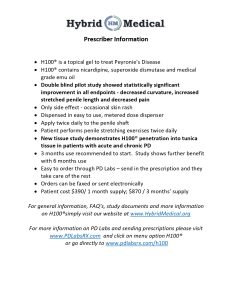
Safety and efficacy of topically applied gel H100™ composed of Nicardipine, superoxide dismutase and emu oil for treatment of acute phase Peyronie’s disease (PD) was evaluated. Twenty-two patients (PD <12 months duration) were studied in a prospective, randomized, double-blind, placebo-controlled study. Eleven patients received H100™ and 11 patients received placebo for 3 months. All 22 patients then received H100™ for the final 3 months. Flaccid-stretched penile length, degree of penile curvature, pain level and side effects were assessed monthly. H100™ showed significant improvement in all PD parameters at 6 months: mean stretched penile length increase (22.6%, P=0.0002), mean curvature reduction (40.8%, P=0.0014), and mean pain level reduction (85.7%, P=0.004). Placebo group showed no significant improvement except for mean stretched penile length increase (6.8%, P=0.009). Crossover patients from placebo to H-100 showed significant improvement in all parameters: mean stretched penile length increase (17.5%, P=0.000007), mean curvature reduction (37.1%, P=0.006), and mean pain level reduction (40%, P=0.17). Treatment was well tolerated. A self-limited rash was the only side effect in three patients. Statistically significant improvements in flaccid-stretched penile length, curvature and pain suggest that H100™ is a safe and possibly effective non-invasive, topically applied treatment for acute phase Peyronie’s Disease.
The study size was relatively small, but its design was done under the guidance of Dr. Larry Levine, a world expert in Peyronie’s Disease. Due to H100™’s mechanism of action, the study only included acute phase patients with developing disease.
Based on our study, maximum benefit was seen after six months of treatment with H100™, though many patients noted improvement after three months of treatment. (1)
A skin rash in the area of application is the only known side effect or adverse reaction in about 10% of patients with H100™ use.
No compounded medication is reviewed by the FDA for safety and efficacy.
Important Note: H100™ gel is only meant to be applied topically as directed for treatment of Peyronie’s disease. It is not intended for any other use. Do NOT take it orally, by injection or through any other method of delivery. For best results, always follow prescribing directions carefully.
TRANSDERMAL APPLICATION OF H100® GEL TO THE PENILE SHAFT IN PATIENTS WITH PEYRONIE’S DISEASE INFILTRATES THE TUNICA ALBUGINEA
JEFFRY TWIDWELL, Minnesota Urology, Minneapolis , MN USA, JOSEPH MAHON, Minnesota Urology, Minneapolis , MN USA, DEAN TORTORELIS, Minnesota Urology, Minneapolis , MN USA, LAURENCE LEVINE, Rush Medical College, Chicago, IL USA
ABSTRACT
Treatment options for Peyronie’s disease (PD) remain limited. Topical H100® gel, (Hybrid Medical, Edina, USA), which contains nicardipine, super oxide dismutase and emu oil showed safety and efficacy in a previous small double-blind placebo-controlled pilot study. The present study evaluates if topically applied H100® gel applied to the penile shaft infiltrates the tunica albuginea. Nicardipine is a key active ingredient in H100® and serves as a surrogate marker. 3 men already scheduled to undergo a planned surgical procedure for PD applied commercially available H100® gel twice daily to the penile shaft for up to 30 days prior to the procedure. Tunica albuginea samples were obtained at surgery. Nicardipine evaluation was performed using isotope dilution technique via liquid-chromatograph-mass spectrometry (LCMS).
All 3 patients tolerated H100® gel application without side effects. All 3 tunica albuginea specimens showed detectable nicardipine in the tunical tissue.
Transdermal application of commercially available H100® gel is able to penetrate the tunica albuginea tissue and is detectable in men with acute and chronic PD. This finding may support the encouraging results found in the prior H100® pilot study.